Sunday, July 19, 2026

Dance into Darkness


Jinty 24 June – 30 September 1978

Writer: Unknown
Artist: Unknown

Della Benson is a typical teenager. She’s utterly self-centred, moody, and lives for the two nights of the week she can escape her boring life and dance at Bats Disco. She even steals the entrance fee out of her mother’s purse when she’s short of cash. She knows it’s wrong, but just can’t bear to miss the disco.

One night she’s dancing when she notices everyone watching someone else, which startles her, as she’s usually the centre of attention. She looks to see a girl she’s never seen before, dressed in dark clothing and wearing sunglasses, dancing better than she could. She tries to follow the girl’s moves, but during a break between tracks the girl comes over and tells her she’ll never dance as well as her because she doesn’t have the secret. She offers to give Della the secret of her dancing skills, but for a price.

Della agrees, assuming that the girl means that she will give her dancing lessons, but demands that she show her first, thinking that once she has learned the secret she can refuse to pay up and the girl won’t be able to do anything.

Della is suddenly dazzled by a flash of light, and when she ca
n see again the girl has disappeared. Thinking little of it, she returns her attention to the music and finds herself dancing better than she ever could before. And then, sooner than she knows, it’s the end of the night and the last song is fading out. She goes home, exhausted, thinking that she must have picked up the strange girl’s moves without realising it. But the next morning, when she wakes up, she finds that she cannot bear the sunlight streaming through her window.


She finds a pair of sunglasses and goes down to breakfast. She tries to tell her parents that she is sick but they don’t believe her, as it’s a trick she often tries.As she leaves the house she gives a classic “You’ll all be sorry” speech that anyone who has ever been or lived with a teenager is likely to recognise, and heads out to school.

Her school friends react in much the same way, assuming that Della wearing sunglasses is purely a wind-up, but when her teacher tries to remove them it becomes apparent that Della really can’t see without them, and the teacher instantly becomes sympathetic, recognising photo-sensitivity as a symptom of migraines and assuming this is Della’s problem.

She sends Della to the sick bay, where the girl is happy to lie around and think about the disco. She recalls that the girl she met also wore dark glasses, and wonders if there is a connection to her problem. Then she hears distant dance music, and follows it to the main hall, where the third years have been given permission to hold a lunch-time disco. Unimpressed by the quality of the dancing, Della determines to show them how to really move and starts dancing.

The teacher who had sent her to the sick bay spots her and tells her to stop, but Della is unable to stop dancing until the teacher switches off the record player, assuming that Della must have been faking her problem earlier. She demands that the girl take off her glasses or get out, so Della runs off, saying that she’ll see a doctor, and then perhaps they’ll believe her.

The doctor can’t find anything wrong with her eyes, but refers her to a specialist and tells her to continue wearing the sunglasses. Della is disappointed that this means she won’t get any time off school. But that evening her father refuses to let her go to the disco, thinking that her eye problems might be the result of too many late nights.

Della is sent off to the chip shop to get the family fish suppers. She bumps into Mary, who is trying to find a 50p piece that she has dropped. She can’t see it in the dark, but Della spots it immediately. She doesn’t say anything, though, and pockets the money as soon as Mary has left. As she returns home, she finds herself being followed by several cats.

Della decides to have an early night, but then hears the cats calling to her. She feels drawn to them, but her father stops her leaving the flat. Realising that her behaviour is worrying her parents, she plays it up even more, using it to emotionally blackmail her mother into agreeing to let her go to the disco.

At the next disco, Della is the first in the door, and dances non-stop until a technical hitch temporarily silences the music. The girl whose dancing Della had admired before comes over to her. She is no longer wearing dark glasses. She asks Della if dancing makes her happy. Della assumes she’s after money and tells her to shove off. The girl says that said there was a price to be paid and that Della has paid it. At that point the lights come up and it’s too bright for Della and she runs outside.

She sees the girl walking away and follows her to a strange dark house, where a woman waits, also wearing dark glasses. She calls the girl Rozelle, and is apparently her mother. The two go into the house, leaving Della outside, wondering how they relate to her situation.

Della sneaks around to the back of the house and spies on Rozelle and her mother talking together. Rozelle says that she returned to the disco to see if the girl she had given her dancing ability to had any regrets. Her mother says that Rozelle need not feel guilty, since the girl had agreed to the conditions of the exchange, and knew the price she would have to pay. Rozelle has to admit that she didn’t exactly explain everything.

The cats that have been hanging around Della start to howl, and Della has to hide when the mother comes out to see them. She follows as the woman strolls through the dark streets with the cats. Then suddenly she is blinded by the light from a motorcycle. and loses sight of the woman. The bike has stopped and its two riders decide to put their transistor radio on to listen to music.

Della is immediately affected by the music and can’t help dancing. She tells them to turn the sound up but they are disconcerted by the strange dancing girl and her cats. Della runs off with their radio and finds herself dancing on a wall, surrounded by cats,when she is blinded by the light from a policeman’s flashlight. The policeman recognises her and takes her home. It’s now three hours since the disco ended and her father has had the police out looking for her.

Once home, Della refuses to tell her parents what she’s been up to, assuming they wouldn’t believe her anyway. Overhearing her parents’ intention to visit her headmistress, she decides to avoid the inevitable scene and play truant. She finds even her dark glasses bring little relief, and slips into a dimly lit clothes shop. Then one of the shop assistants puts on some music and Della cannot help dancing to it, so they throw her out. Eventually she takes shelter under the old river bridge, as it’s the only place she can find that escapes the glare of the sunlight.


After several hours Rozelle finds her there, having been searching for her. She explains that her whole family has been living under a curse for generations to live in darkness. There is no cure, but the curse can be taken over by another person in exchange for a gift or favour. Della responds that she has done her no favours, but Rozelle reminds her that she wanted to dance like her with all her heart, and agreed to pay the price to make it happen. [1]

Della tries to follow Rozelle as she leaves the shadow of the bridge, but she’s dazzled by the glare and falls in the river. She returns home and attempts to explain about the curse, but her parents think she is suffering from psychological problems. Alone in her room, she thinks back to what Rozelle had told her, and rationalises that if she can resist dancing to music then she might be able to break the curse. She switches on her radio, but is unable to resist for more than a few minutes. By the time her parents come in to see what the noise is, she is begging for them to switch off the music.


Della runs away to escape the music, forgetting her sunglasses. But she doesn’t need them so much now that it is pitch dark. She determines to confront Rozelle and make her remove the curse. She is met at the door by Rozelle’s mother, but pushes past her into the house. Rozelle lights candles, which cause pain to both her mother and Della, but she is revelling in being a normal girl and all she wants to do is make up for all her years of darkness by filling her world with blaze and glitter.

Next morning, Della is back at school. But now she has a plan; she’s going to play the same trick on someone else that Rozelle played on her, and pass the curse onto them. Her problem is finding something that someone else wants that she can provide. The only person that seems like a viable possibility is her best friend, Anna, who wants the autograph of a pop star. Della really doesn’t want to pass her misery onto her best friend, but when it seems like this is the only chance, she goes to where the pop star will be making an appearance and tries to get his autograph.

All seems to be going well, but then the shop starts playing music and Della has to dance. Her sunglasses get knocked off and she is dazzled, falling into a display. Just then her headmistress arrives, checking to see if any girls have played truant to come along to the signing, and only to find Della still dancing amongst the broken records, with the police not far behind. Della is suspended from school and taken home by the police again.

It’s a week before Della is allowed back to school, and once there she finds that all her friends have turned against her. The trouble she caused at the record shop has got all the girls banned from it, and even Anna is mad at her for not getting her the autograph she wanted so much when she had the chance.

Della attempts to get away and hide in a nice dark store room, only to find it’s already occupied. Whining Winnie, the creep of lower school is hiding from bullies. It occurs to Della that Winnie would do anything for friendship, and thus make the perfect person to take over the curse.


 Della offers to become friends with Winnie if she will do her a favour in return. Winnie immediately agrees, but by the end of the afternoon nothing has happened. She invites Winnie to come round that evening to do homework together, finding that now she’s starting to get to know her, she doesn’t seem so bad. She even feels a little guilty about condemning her to darkness, but not enough to halt her plan.

Seeing Della and her new friend actually studying, her parents are quite taken with her, and when Winnie mentions that she likes jogging, they allow the two to go out, forgetting that Della is grounded. Della is delighted at being able to get out into the night, and revels in it. When they reach a local park, Winnie is awestruck by how the wildlife congregate around Della. Foxes come to curl up at her feet and owls perch on her shoulder. It occurs to Della that Winnie might actually enjoy some aspects of the curse.


Before long, Della begins to get fed up of Winnie’s crush on her, but there is no sign of the curse transferring. She visits Rozelle for advice but finds the formerly dark and shuttered house blazing with light. There are mirrors everywhere and everything is polished so that it shines. Rozelle’s mother is now relegated to the cellar, being the only place in the house dark enough for her now.

Della explains her situation with Winnie, and Rozelle points out that what Winnie desires is true friendship, and Della is just faking it. The curse won’t transfer until Della becomes her real friend.

It’s not long before Della bumps into Winnie again. But then, as they are crossing a road, a waiting car starts playing music and Della is forced to dance again. The traffic is held up and everyone is looking at her, but she can’t stop while the music is playing. Then Winnie slaps her and the spell is broken. Some girls who have watched the whole thing are laughing at Della’s antics, but Winnie stands up to them on her behalf.

Della is surprised and impressed by Winnie’s fierceness and loyalty, and at that moment Winnie gets a flash of pain in her eyes.

Returning home, Della’s mother tells her that the appointment with the eye specialist will be the next day. Della doesn’t want to go, partly because she thinks she’s found a way to get over her condition, but Winnie offers to go with her to support her.

At the hospital Della admits she is a bit nervous, but finds it very calming to have Winnie around helping her. Winnie trips over a trolley as the light momentarily becomes too much for her.


The specialist decides to admit Della to the hospital for tests. Della is surprised when he recognises Winnie and chats with her about her sister, who it transpires is blind. As they leave the hospital Winnie shrinks from the brightness, and Della begins to feel bad about what she’s doing.

A few days later Winnie asks Della to take her to the disco that everyone talks about so much. Della is reluctant, knowing how it will affect her, but agrees to in order to please Winnie. Several of her former friends are there, and their catty remarks makes Della realise how much she values Winnie. The curse seems to be transferring, as Winnie suddenly wants to be out in the darkness, and the streetlights aren’t hurting Della’s eyes, but then she makes a sarcastic comment to the girl and it all comes back to her.

Winnie takes Della home to have some supper with her sister, but meeting the blind girl makes Della realise that she can’t go through with condemning both sisters to darkness, and leaves, telling Winnie that she isn’t her friend.

The next day Winnie isn’t at school, but the pupils are informed of a school trip to some caves. Della is determined to go, hoping it will give her a break from the blinding sunlight. But she hasn’t taken account of how well lit the caves are, and gets no relief. Then the lights go out, and Della realises she’s the only person who can see in the blackness. She offers to lead the others out if one of them will take over her curse of darkness.

The girls don’t believe her at first, but refuse to play her game, so Della decides to wait them out. But soon Anna begins to crack up in the darkness, and Della can’t bear to see her suffer, so she leads the girls out of the cave. The girls now think she’s a hero but she won’t accept their praise.

Della now realises that she will never be cruel enough to pass on the curse, and she’s going to be stuck with it forever.

And then Rozelle turns up at her door. She too, has seen the error of her ways. She has a wonderful new life, but can’t share it with her mother. They were once so close, but now can’t bear to be together. She has decided that she wants her curse back.

The two clasp hands and Rozelle makes a bargain to give Della her perfect sight and the curse is exchanged. Rozelle tells her they will never meet again because night people can’t have friends. Della points out that there is in fact a place where day and night doesn’t matter.

An epilogue at Bats disco finds Della and Winnie friends again. Winnie sees Rozelle dancing [2] and asks Della if she envies her. Della replies that Rozelle has made her appreciate what she already has..


 The writing in this story is excellent. Everyone behaves like real people, and the story flows naturally from this. Della is so completely fallible; she’s willing to try tricking even her best friend into taking the curse for her, but when it comes down to it, it turns out that under all the selfishness she can’t actually go through with it, and she’d rather keep the curse herself than make anyone else bear it.

There are a lot of stories in girls’ comics where a bad girl does bad things all the way through the story and then in the last episode has a change of heart, but they rarely ring true. Della’s really does, because she’s never actually done anything that bad, and it’s only when she is faced with the real possibility that she makes her choice. And she still feels guilty about it because she came so close.

And it’s not a happy ending, where everything is nice for everyone. It’s a realistic ending, where Della and Rozelle are both better people for having learned something important about themselves, but Rozelle and her mother are still cursed.

The story is full of vampire themes, from the name of “Bats” disco to the curse involving elements associated with vampires: sensitivity to sunlight, a relationship with nocturnal creatures; but they are used to evoke the supernatural flavour associated with vampires without limiting it to being a vampire tale. The curse itself remains very vague. “It’s the family curse laid on us in medieval times.” That’s the entire explanation. You could tell a whole other story about the curse; give its history, and have the characters ultimately find a way to break it. It would be big and dramatic and have lots of special effects. There are lots of stories like that. But this story isn’t about the curse. It’s not big and it’s only a little dramatic. It’s not about the curse, it’s about people dealing with the effects of the curse.

A particularly clever piece of storytelling is the way Della traps herself with the bargain she makes with Winnie. She can only succeed at giving her the curse by becoming a good enough friend to her that she wouldn’t want to give her the curse. It’s an excellent twist, and entirely her own fault for not thinking through the implications of the deal.

The art is also very good. It’s full of emotion and uses an exuberant layout that is barely restrained by panel borders, with bits regularly bursting out and overlapping. It’s very close to overdoing it and becoming an incoherent mess, but doesn’t quite tip over. It does occasionally look a little rushed,[3] but is mostly very good, and has some excellent touches, like reflecting Della’s face in Rozelle’s sunglasses when they are first making the deal (see 2nd image above), and does a good job of suggesting complete darkness, while still enabling you to see what’s going on.

If Egmont want to resurrect the Misty brand I could see this being a perfect fit. Make it a 64 page issue with Dance into Darkness and a couple of twist-ending shorts and you’d have a strong collection that would appeal to teenagers and adults.


  1. she doesn’t say anything about the dancing ability being a compulsion, but perhaps that’s just an extra monkey’s paw-type twist to the curse – you take on the curse to get something you wanted, but even that is spoiled. It’s a minor niggle that this isn’t addressed in the story.
  2. She seems to have got her dancing skills back along with the curse.
  3. It baffles me that one of the few poorly finished images was used as the basis for a cover, which just looks ugly.

We're back!

After a short [1] hiatus this blog returns. Possibly, maybe. It was originally continued on a Wordpress site, but sadly when that went down a lot of the material there was lost. Happily, not all, though. And the first order of business is to repost the entries I do have. 

Marionette 


1) 13 years is short, isn't it? 

Thursday, July 25, 2013

The Girls of Liberty Lodge

Tammy 6 February - 7 August 1971

The Girls of Liberty Lodge is another mistitled story. Similarly to No Tears For Molly being about a girl who weeps at every opportunity, The Girls of Liberty Lodge is in fact mostly about the teachers of Liberty Lodge.

This strip also introduces us to that staple of girls' comics, the evil headmistress/teacher who will stop at nothing to get her way. The novel twist being that the evil headmistress is principal of an entirely different school. That school being Hardington Hall, where the story opens. It is a very strict school, where pupils who infringe the rules are put through a show trial in front of the entire school, with Miss Steele the headmistress playing judge and prosecution (defense counsel being superfluous to requirements). They are then locked up in the punishment room when they are inevitably found guilty.

Sally Valentine, a new, young teacher defies Miss Steele by visiting a girl in the punishment room, and when she is caught, speaks out against their cruel measures. She resigns before she can be fired, and takes the opportunity to start a different type of school that she's had in mind for years, bringing in her friend Miss Timmy as the only other permanent teacher we see at the school.[1]


In fact the actual specifics of how Liberty Lodge works are not given. There's some vague talk about the pupils having a say in the running of the school, and being allowed to choose which lessons to attend, but it's a long time before we see any details of the philosophy in practice. There's never any hint of the girls taking any exams.


Miss Steele takes against Miss Valentine and Liberty Lodge with impressive monomania. It would be wrong to say that she falls back on illegal methods to shut down Liberty Lodge as a last resort, because that's her starting point: setting Miss Valentine up as a thief after having an accomplice buy a vase from Miss Valentine using money which she can then claim as stolen. When it gets out to the parents [2] that Miss Valentine has been arrested for theft, they all withdraw their girls from the new school, and it looks like Liberty Lodge is over before it's started.

Luckily for Miss Val [3], former Hardington student, ex-Liberty Lodge girl and now Hardington pupil again, Mary spots Foxley, the accomplice, coming to visit Miss Steele and... talk about the illegal things they got up to. And spend enough time doing it for Mary to phone Liberty lodge so Miss Val can rush over, sneak into the school, and still manage to catch them saying incriminating things to each other on tape. With the threat of going public she is able to get Miss Steele to drop criminal charges and tell everyone it was a mistake. All the girls come back to Liberty Lodge and Miss Val never thinks to use the threat again.

Miss Steele's next ploy[4] is to send her niece Sandra to Liberty Lodge as a pupil to sabotage the school. Sandra does play a few tricks; setting fire to the art hut, misdirecting the girls during a climb, and puncturing their tires at the start of a cycle race; but she is soon won over to the Liberty Lodge side and is forgiven all the criminal damage and putting girls' lives in danger.

Miss Steele takes a step back at this point, letting her pupils take the lead in the vendetta. There's a hockey match between the two schools where the Hardington team cheat outrageously, fouling the other side whenever they think the referee isn't looking, and a narrow boat race where, again, the school known for strict discipline cheats at every turn. The Liberty Lodge girls always win, of course, because they are friendly and kind, but mostly because they are incredibly lucky. For example, during the narrow boat race the Hardington girls switch signs, causing the Lodge girls to go the wrong way, except they meet some nice people who show them a shortcut.

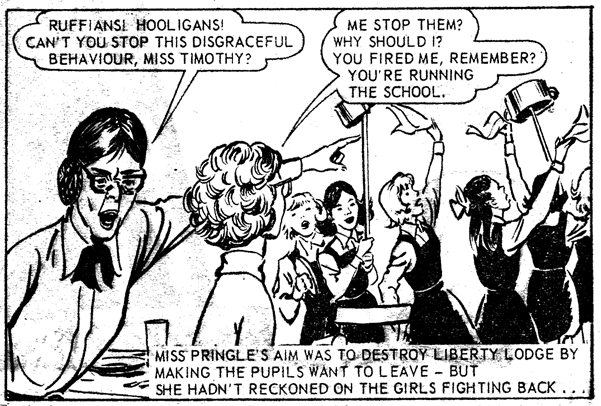
Undeterred, Miss Steele hires Miss Pringle to pretend to be the supply teacher Miss Val brings in to substitute for her while she visits a sick aunt in Ireland. Miss Pringle has a faked letter from Miss Val, saying that she is to take over as headmistress. She then proceeds to institute all kinds of draconian policy changes that are the opposite of Miss Val's philosophy[5] in an effort to encourage the girls to leave the school. Instead, the girls rebel, standing up to Miss Pringle and refusing to go along with her rules.


Miss Pringle is entirely incapable of dealing with pupils who think for themselves and refuse to obey unfair rules, which suggests that she is perhaps a former teacher at Hardington. Given her criminal behaviour, it's hard to see that anyone who didn't have some existing relationship with Miss Steele would be prepared to go to such lengths in pursuit of her one-sided feud. Unable to cope, she calls Miss Steele for help, and the deranged headmistress sends a group of senior prefects to join the school temporarily and act as Miss Pringle's enforcers.

But even this does not stop the Lodge girls, and it is only as Miss Pringle is preparing to flood them out that Miss Val turns up and all is set to rights.Once again Miss Val chooses not to bring a criminal prosecution against Miss Steele. After all these attacks on the school there's no reason to believe she would stop now, so Miss Val's failure to even threaten her with the police if she doesn't cut it out seems rather foolish.

 After a short and pointless episode about an amnesiac heiress [6] we come to the final story, where the two schools have to participate in a series of competitions to win a prize. Hardington Hall cheats all the way through and wins, but it then turns out that an even bigger prize had been set aside for the school that behaved the best, which of course, goes to Liberty Lodge.


The Girls of Liberty Lodge is not one of Tammy's better stories. It has some interesting ideas, but they are never explored very far, and most of the individual storylines are a bit dull and predictable. Only two of the girls of Liberty Lodge regularly appear in the series, Mary and Sandra, and they are very much supporting roles to the teachers. Unlike Betina at Ballet School there's no larger plot or themes, it's just a series of incidents where the bad guys behave badly and the good guys behave well and win. And despite being a story about two schools, nobody ever learns any lessons. In the end the heroes do win, but the villains don't exactly lose. They just get a prize that's not quite as good.

Ultimately the most interesting thing about the series is how a school that has a fascistic level of discipline and adherence to rules can also promote cheating at every turn. One is left with the impression that Miss Steele's devotion to rules only extends as far as those she has personally introduced; any rules set by, for example, the organizers of competitions, or even the laws of the land, can be flouted if it serves her personal interests.


Notes.
1) Although it has a lot of temporary ones. And even the ones who aren't plants by Miss Steele have some kind of baggage.
2) Because Miss Steele phones them all up to tell them.
3)As she is known to her girls.
4) The only reason I can think of that anyone goes along with Miss Steele's increasingly bizarre and illegal behaviour is that they are so used to the strict discipline of Hardington Hall that nobody dares to question the headmistress' decisions.
5) And blatant copies of Hardington Hall policies, like the punishment room.
6) Tammy is full of stories about amnesiac heiresses. At one point it has three running simultaneously.

Saturday, July 20, 2013

No Tears for Molly

Tammy 6 February 1971 - 21 November 1981

One of Tammy's two signature serials (the other being Bella), and the only feature in the opening line up to last more than thirty issues, No Tears for Molly [1] told the story of young servant girl [2] Molly Mills, 
and her abusive relationship with Pickering the butler at Stanton Hall from 1926.

She arrives at the same time as her perennial nemesis, although a year later Pickering would be described as having worked there for "a couple of years", implying that his arrival had predated Molly.  They get off to a bad start [3], but it soon becomes evident that "nasty" is just Pickering's default setting, going well beyond anything reasonable in his punishments of those he is responsible for, though no one gets it as bad or as often as Molly. He regularly hits her, but more creative punishments include locking her in a pillory, tying her up in a deserted tower, forcing her to stay up all night working, and at one point locking her in a flooded dungeon. How he gets away with this behaviour is unclear, though the rest of the staff's limp acceptance of each new attack doesn't help.

The format breaks down into a series of individual stories each running for several issues. They are episodic, but with no ongoing subplots or character arcs. Nobody is ever really changed by the dramatic events that occur and everything defaults back to the status quo at the conclusion of each story. To the point where characters even seem to forget events that happened in previous episodes.[4] This is not to say that there's no carry-over. A character who comes to visit in one story may well return at a later date, and the previous episode may even be referenced, but nothing substantially changes.

As far as I've read, anyway, so feel free to correct me in the comments (but don't give away too much. The story may be forty years old but it still counts as spoilers to me). There remains a lot I have yet to see, but a glance at an issue from 1981 finds essentially the same cast looking much the same age, and although the date does seem to move forward in real time, nothing really seems to have changed in ten years.

Interestingly, Molly isn't quite the complete innocent, unjustly tormented, like many Tammy protagonists. Of course Pickering's bullying is so far beyond reasonable reaction as to be clearly over the line into criminal abuse, but Molly so regularly disobeys explicit instructions, often for little substantial reason, that it's only because the narrative supports her as the One Whose Heart is in the Right Place and arranges for her sometimes thoughtless actions to turn out to be the right thing to do, that gives her any moral high ground.

For example, one story [5] has Molly going ghost hunting in the unused east wing of Stanton Hall despite it being categorically stated from the start that it's an out of bounds area, and a firing offence if she was caught there. She has no excuse; no cause. She just goes there because she's curious, after finding a secret passage that leads there . In fact she is spotted by Betty and Kitty, who see her at a distance, mistaking her for the rumoured ghost, which then gets wildly exaggerated in the retelling, precipitating subsequent events of the story.

No such ambiguity with Pickering. He's always mean, always nasty, and always in the wrong. He's also a complete coward, crumbling at the merest suggestion of threat toward him. Which somehow none of his victims ever think of exploiting.

"Lots of Tears for Molly" would have been a more accurate title.Other members of the cast downstairs include Molly's two friends among the staff, Cook (is she ever given an actual name?), and Charlie the boot boy, plus two petty and spiteful servant girls, Betty and Veronica Kitty who often seem to be oblivious to the story in progress, and serve only to provide extra obstacles for Molly, like the time they push her in the fountain for a laugh when she's in the middle of trying to save someone's life. Upstairs there are Lord and Lady Stanton, and their wheelchair-bound daughter Mistress Clare (also a friend to Molly, often supporting her against Pickering), but the Stantons disappear from the narrative for long stretches. They also seem to have an inordinate number of guests, as many stories will revolve around people who are visiting the hall, even though their hosts are often nowhere to be seen. Other staff appear as individual stories require, and then vanish again afterwards, sometimes never to be seen again.

 Originally I thought that the series had been inspired by the popular period drama Upstairs Downstairs, but a little research finds that while both débuted in 1971, the comic strip predates the TV show by six months. It's a topic that seems to be a perennial favourite, with Downton Abbey being the latest drama to focus on what goes on among the servants in a great house as much as it does with the owners. Tammy, being Tammy, is more interested in the working class domestic staff than the upper class family.

The writing, by Maureen Spurgeon can be entertaining, often finding creative ways of bringing the most unlikely characters and situations to Stanton Hall, but this seems an effort to cover the lack of any real knowledge about how domestic service actually worked, and the complete lack of any depth or development in the regular characters, which makes anything character related repetitive and irritating after a while, and the amount of violence routinely directed toward Molly is disturbing.

The art by Tony Thewenetti isn't as slick as Jean Sidobre; it doesn't have the emotional depth of Dudley Wynne or the attention to detail of Giorgio Letterati, but it works for this strip. Molly herself is depicted as young and vulnerable, while Pickering has a permanent frown. There's clearly no lack of research in the art, as everything Thewenetti is asked to show is portrayed in realistic detail, from gypsy caravans to circuses to zoo animals. His main fault is that he's not great at showing movement. Whenever somebody is supposed to be running it looks a little stilted, and he uses the same bent leg pose all the time. He stays with the strip until 1977. I don't think the artist who follows him is anything like as good a fit, but we'll get to that another time.


Notes:
1) Later shortened to Molly Mills, with individual story titles, perhaps because somebody pointed out the original title was so inaccurate; barely an episode would go by without Molly bursting into tears
2)Her job title is never specified, even though the hierarchy of domestic service of the period was rigidly defined. She's certainly some kind of maid; the variety of work she is seen doing most often suggests chamber maid, though the vagueness about anything job-related in the primary cast makes it easy to infer that despite writing it for ten years the writer never got around to doing the research.
3) Molly's fault for not looking where she's going and knocking his suitcase off the platform where it immediately gets run over by a train.
4) In the issue dated  1 July 1972 Molly states that it's the first time she has seen a circus, forgetting that she went to one a year earlier in the 17 July 1971 issue. It must be all those blows to the head causing her memory loss.
5) Begins in issue dated 18 March 1972.

Tuesday, July 16, 2013

Dawn and Kerry Double for Trouble

Tammy 6 February - 20 March 1971


Unlike most Tammy serials, Dawn and Kerry Double for Trouble is character based, rather than plot based. By which I mean that there is no overarching plot, no long term goal to be reached.  Kerry and Dawn are just two friends who accidentally trip over Scooby Doo style plots every so often. They don't learn from it. They aren't changed by it. They just continue on until it's time for something else to happen to them. Their initial run is the shortest of Tammy's initial line up, but they return for a second adventure a few months later.

In an opening so clichéd that it would turn up as a parody in The Rocky Horror Show only a couple of years later, friends Dawn and Kerry are caught out in the rain and forced to seek shelter in the nearby spooky mansion Whispering Heights. They've barely had time to duck under the cover of the courtyard before they are accosted by a large unfriendly man and an old woman. These are Madam Sahl and Gerald. They will be our villains for this adventure.[1]


Why the two villains are wandering around in the rain is never explained, but perhaps they saw the girls approaching the house and decided to head them off into the exact place they wanted to keep them away from.

The rain lets up a bit so Dawn and Kerry leave, but before they've got far Kerry notices her purse has gone missing. In fact we can see it knocked out of her bag when the villainous guy was pushing her around earlier. Sneaking back to search for the purse, the two girls find a staircase leading down that they'd failed to notice before [2], and decide to nose around, because nothing gets the curiosity up like large unfriendly men pushing you around and monocle-wearing old women telling you to leave.

Downstairs the find a girl locked in a dungeon.They immediately manage to get themselves locked in with her[3], but are able to escape when the villains let the girl, Victoria, out to have dinner. The two sleuths run to the nearest police station for help, but when they return to the spooky mansion the villains deny ever having seen the girls, and perplexingly, so does Victoria.

As they leave, Victoria passes a note to Dawn[4] that reads:
I have done a dreadful thing that must not be known by the Police, and I owe everything to Madam Sahl for keeping my secret. Thanks for trying to help, but keep away from Whispering Heights - for your own sakes.

Victoria.[5]

Dawn and Kerry immediately plan to return to Whispering Heights and so, for the sake of plot, walk twenty minutes back to the hotel run by Dawn's aunt Betty, where they are staying. Aunt Betty sets them to work, cleaning the place in preparation for two very distinguished looking visitors.[6] It's plot convenience theatre here, as we are informed that Mr and Mrs Courtney-Bingham are only staying at the hotel because their car broke down, and before the page is over Kerry has accidentally caused one of their suitcases to fly open revealing a photo of Victoria helpfully inscribed "To darling Mummy and Daddy".

Mr Courtney-Bingham bursts in for some reason, catching the two going through his luggage. Kerry tells him that his daughter is being held prisoner at Whispering Heights but despite all the evidence to the contrary, he denies having a daughter or ever having heard of the place that Aunt Betty is even at that moment phoning for a taxi, at his request, to take him to.


But it must be a very slow taxi or a very busy day for them, as it's only just arrived as Dawn and Kerry get to Wuthering Whispering Heights. They hide behind an open window to listen in but strangely the clear glass pane does not hide them very well and they are spotted almost immediately. Realising there's no way they'll be rid of the two pests until they tell them what's going on, Courtney-Bingham explains that Victoria's father was his best friend, and that Victoria never recovered from the death of her parents, acting strangely and even becoming violent. Dawn refuses to believe this, but after Victoria runs out of the room Madam Sahl follows her and as soon as she is out of sight, shouts for help.

Running to her aid, they find Madam Sahl at the bottom of the stairs with Victoria standing over her. Sahl claims that Victoria pushed her down the stairs but Victoria denies it, but then starts talking about the voices in her head.

It's raining again, and so Madam Sahl invites the interfering girls to stay for tea. But the weather only gets worse, and so, rather than phoning for a taxi to take them the couple of miles home, Madam Sahl insists they stay the night. But they are barely settled in their bedroom before a note is slipped under the door. The note reads:

Please come to the room at the top of the stairs - Urgent!

Victoria

Ascending the stairs, they open the door to find only empty space. It's a sheer drop to the ground. Madam Sahl and Gerald appear behind them and explain that it once led to the east tower but that the staircase rotted away ages ago.[7] Kerry tells them about the note and they go and confront Victoria. Victoria agrees that it's her handwriting, but doesn't remember writing the note. Then Madam Sahl spots the key to the treacherous door beside Victoria's bed.


Dawn is suspicious, and so once everyone has gone back to bed, she determines to confront Victoria in her bedroom in the cellar.[8] Victoria starts talking about hearing voices again, and right on cue, loud voices start booming into the room.
Dawn immediately traces the voices to a tape recorder hidden in a ventilation duct. She then investigates Madam Sahl's study and finds a blotting paper copy of the note that was left to them, along with Victoria's note book, which they deduce enabled Sahl to forge her handwriting.

The plot then becomes clear. Courtney-Bingham, who conveniently seems to have left the house despite the rain that kept Dawn and Kerry from leaving, is the administrator of Victoria's parents' estate, and Madam Sahl and Gerald are employed by him to run Whispering Towers and look after Victoria (and her trust fund) until she comes of age. With Victoria thought to be insane then they get to keep control forever.

Before Kerry and Dawn can escape to tell anyone, Madam Sahl and Gerald burst in and catch them. Gerald drags them off to throw them through the east wing door, but Dawn manages to hit him over the head and knock him out  with a conveniently placed morning star. The girls then go looking for Victoria, and split up so that Madam Sahl can catch Kerry alone and knock her out, and then lure Dawn up to the east wing door to push her through to her death.


But it turns out Kerry's head is far too hard to be stunned for long by a tap like that, and she yells a warning, causing Dawn to duck, and Madam Sahl to go flying through the door. But the murderous old woman manages to hang onto the ledge, and the girls pull her up. Plot convenience theatre then resumes as Mr Courtney-Bingham turns up again and brings in the police, and the villains confess all, wrapping up the story in half a page.

This last part is clearly rushed to finish off the story to make room for the upcoming merger with Sally. But even so, I'm not sure it would have run more than one more episode. It's just that the story is already so compressed that squeezing it down even further is painful. Particularly where Dawn and Kerry spot the returning Courthey-Bingham's car (which they can't have seen before to recognise) through the deadly doorway, which we have been told only a page earlier was a hundred foot drop, and also appears to be on the other side of the house.


Aside from that, the story is... okay, I guess. It's sub-Scooby Doo "We would have gotten away with it if not for you meddling kids!" fare. Written by Maureen Spurgeon (who also did Molly Mills), it does get horribly contrived in places, which is partly a function of the compression needed for a strip that only runs two pages per issue, but in some places it's just lazy, where the writer has stuff happen purely to fit the plot, without any effort to make it work as story. There are odd moments of humour that do work, but there's not enough of them to pull the story out of its ordinariness or offset its myriad problems.

The art by Giorgio Letteri is much, much better than the story deserves. It is clear and descriptive. When the story tells you that Dawn's purse has fallen out of her bag, you can go back a page and see it happen. When Victoria slips her a note, you see that detail in the picture. When the weather gets bad, you can see lightning through the window in the background. When the story says there's a hundred foot drop from the east wing door, you see a hundred foot drop from the east wing door. Which is a little unfortunate when a page later the art has to contrive to also show the front drive visible from the same door.

We will see more from Dawn and Kerry later, when they trip over another mystery.


Notes:
1) These are so obviously the villains of the story that we can see it before we even know what the story is about. The old woman is even wearing a monocle. Nobody who was up to any good ever wore a monocle in British comics (not counting Jemima Carstairs, who wasn't technically in a comic). Even Richard O'Brien, when designing flamboyant costumes for his parody homage to 1950's SF and horror B movies stopped short of giving anyone a monocle.
2) even though they'd been so close to it that the purse is found halfway down the steps.
3) I'm not sure how that works, either, since they unbolted the door when they went in. And why did they go in anyway?
4) It is hard to tell them apart at times, but of the two, Dawn is the more sensible and Kerry the more impressionable and flighty.
5) This dreadful secret thing is never referred to again. It could refer to the voices or some other staged incident, but it seems awfully specific.
6) If she's waiting until after they've booked in to tidy up the place then I'm not sure the guests are going to be that impressed.
7) As did, apparently, the east tower, which is not visible in any of the panels featuring this door. And doesn't it let the rain in, being an internal door now having to do the job of an external door? Why hasn't it rotted away?
8) If this is the same cellar room she was locked in at the beginning of the story, you may recall that it was a plot point that not only was it bolted shut, it couldn't be opened from the inside even when the bolt wasn't on it, so how is Victoria supposed to have got out to leave the note? And if it's not, why is Victoria sleeping in a cellar?

Monday, July 8, 2013

Betina at Ballet School

 Tammy  6 Feb 1971 - 24 July 1971

I think it's probably a law that every British girls' comic has to have a ballet story. They are certainly ubiquitous prior to the 1970's. Tammy's initial contribution to the genre sets out one of the major differences between its style and what had gone before: typically, girl's comics had been about middle and upper class girls, often at boarding schools. In Tammy, these girls were the villains. It's class warfare all the way as Tammy's working class heroines, without class privilege or financial support, and armed only with talent and determination, undeterred by the entrenched cliquishness and spiteful jealousy, invade and conquer story lines previously open only to the posh girls.

Betina Brooks is the working class daughter of a charwoman, and she is obsessed with ballet, even though everything she has learned has come out of books because her family is too poor for her to ever have had proper lessons, or, presumably, been able to actually afford to go see a real ballet.

As the story opens, Betina is excited because she has an audition for a ballet scholarship. But she's nervous and screws up her routine. By a massive coincidence one of the members of the scholarship board is her mother's employer Miss Knight, who just happened to catch Betina dancing for fun in the previous scene, and so knows what she is capable of, and she personally sponsors Betina for the scholarship, and in fact takes her for an audition at the "best school in the country"[1], the famous Vronskya Ballet School.

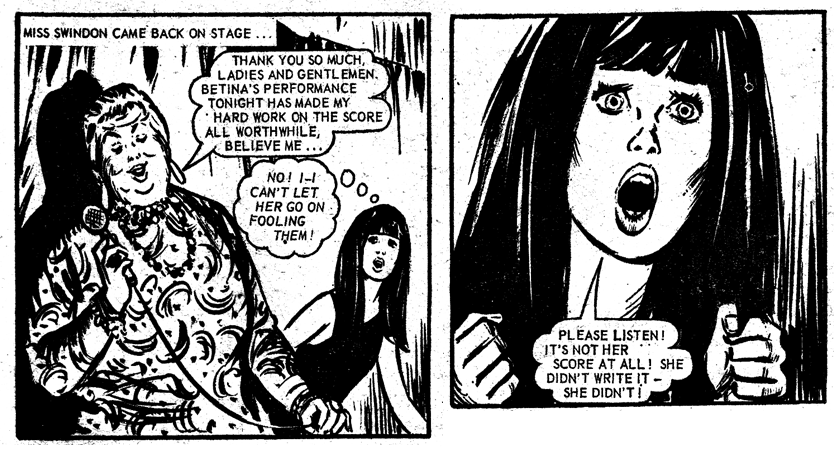
Betina dances for Madam Vronskya and her "assistant" Miss Swindon.  Madam sees great promise and immediately accepts her, but later Betina overhears Miss Swindon scolding her for accepting "a common urchin" into the school.

Despite these portents, Betina is delighted to arrive at the school and dance in a real studio with a proper barre and mirrors. Her enthusiasm isn't even dampened by the catty remarks of her snobby classmates. But then it all goes horribly wrong. First Madam keeps singling her out for making mistakes when she's sure she is getting it right, and then she claims that Betina is not the same girl they saw at the audition, and she must have hired a professional dancer to cheat her way into the school. Miss Swindon later tells her that Miss Knight has been informed and Betina will be sent home.

Left alone in the hall where a pair of Pavlova's[2] ballet shoes are on display in a helpfully unlocked case, Betina takes the only opportunity she will have to dance in them. Madam catches her, but instead of reprimanding her, she bursts into tears and apologises to Betina before rushing away.

Later Miss Swindon returns to tell Betina that Miss Knight has suffered a stroke and is critically ill in hospital, and was unable to give any instructions regarding Betina. She says that Madam Vronskya has offered to keep Betina at the school as a cleaner.


Why does Miss Swindon accede to this plan of Madam's to keep Betina at the school? There's no specific reason given in the story, and Miss Swindon has been against her from the word go, so why keep her around? Given what we later find out about her, my guess is that it's a scam. Betina is on a scholarship (or is being paid for by the currently unconscious Miss Knight; it's not clear), so presumably the fund that finances it will continue to keep paying out her fees so long as Betina is still there (and Miss Knight is unable to do anything about it). Keeping her there as a skivvy means that she doesn't get to bring the snobby tone of the school down by being a student, while still providing a nice little revenue stream, and supplying some light housework on top. Or it could just be the attraction of Putting the Riffraff in Her Place and keeping her there for all to see.

As an aside to those who may be more familiar with the current, decompressed style of comics storytelling, I thought I'd mention that we are at this point barely six pages into the story. By comparison, it took the current Ultimate Spider-Man more than ten times as many pages to get as far as putting the costume on. You can see why most serials only ran three pages per issue.


The other servants [3] don't take kindly to Betina, believing the lie about her cheating to get in, but just as Betina is getting really depressed Madam shows up and tells her to meet her secretly after supper.

Madam begins giving Betina secret ballet lessons in the attic of the disused coach house. Some of the pupils start to accept Betina after the particularly mean Lucilla plays a prank with the Pavlova shoes and Betina gets blamed. However, the secret classes don't last long, as without warning or explanation Betina is kicked out of the school.

Returning home to her mother, Betina later reads in a newspaper that Madam Vronskya has left the school to teach abroad. Betina writes to one of her newfound friends at the school, Diana, who turns out to be a bit of a sleuth as she is able to supply Betina with the address that the taxi took Madam to; not the airport, but the slum end of a nearby town. Betina tracks her down and she explains what's been going on.

It seems Madam Vronskya is a fake. Her real name is Doris Kent, and she'd never been a ballerina, but she was a great teacher. So when Miss Swindon asked her to pretend to be a famous Russian dancer [4] and official face of the school, she accepted in order to be able to train "the great dancers of tomorrow". But she hadn't realised she'd mostly get spoilt brats with no talent and little interest. And after Miss Swindon refused to let her teach the one pupil she'd had with any actual talent (Betina, of course), they had a great row and she walked out.

Betina takes Madam back home with her, but things are barely settled again before Miss Swindon shows up looking for her. Apparently she doesn't have Diana's detective skills. The replacement ballet teacher is hopeless and she wants Madam to return. Madam agrees, but only on condition that Betina is reinstated, and so finally Betina is a pupil at the ballet school again.

You'd think the story would now settle into a more typical school-style episodic storyline, and it does start that way, with Lucilla and friends causing trouble and Betina dealing with the consequences, but with each twist and turn the plot builds, working from a straightforward prank to steal Betina's ballet shoes leading all the way up to where only them putting on a production of Petrushka, filmed for a TV documentary, can possibly save the school.

Things do settle down a bit after that as the final one of the three story arcs starts moving, with Miss Swindon, having finally accepted that Betina has talent, determines to make money out of her by having her enter lots of ballet competitions and win prizes [5].

Meahwhile Betina makes a friend of  Sophia, a new pupil who is a Russian princess. But it's okay, despite being technically aristocracy, she comes from a poor, single-parent family and is positively the opposite of snobbish, preferring to go for a picnic in a rag and bone lorry [6] with Betina and her mum than lunch at the country club with the posh girls.

In fact it's while the two are dancing on the river bank to entertain their companions that they are spotted by the director of a modern dance company, the Ballet Workshop, who invites them to come join them. Betina is very tempted, seeing it as the opportunity to continue her studies with people who actually liked her, as well as escaping the pressure she is under to win one competition after another with hardly a break between to recover. But ultimately she refuses out of loyalty to Madam.

Visiting the workshop a few days later, she joins in a practice and they again invite her to join, inviting her to bring Sophia and Madam Vronskya with her. When Miss Swindon finds out, the prospect of losing the only real talent the school has to boast sends her over the edge and with Lucilla's help she fakes a burglary, framing Betina for it, and then uses the threat of going to the police to blackmail Betina into stealing a copy of a new score the Ballet Workshop are working on, to use it to put on a production, claiming it as her own work, which she believes will make her famous.

How she thinks she'll get away with this, when it's so well known as a Ballet Workshop production that she herself found out about it from reading about it in the newspaper, or how long the faked burglary threat is going to hold up when her blatant theft, blackmail, and plagiarism are exposed, I have no idea. I think by this point she has actually had some sort of psychological break and is no longer at home to mister logic.

 Inevitably, Betina being the heroine she is, she dances the ballet but then cannot bear to allow Miss Swindon to take the credit, and confesses all. A woman in the audience supports her, turning out to be a dancer from the Ballet Workshop. Miss Swindon plays her final card, denouncing Betina as a thief, but by this point even Lucilla has had too much (or knows when it's time to switch sides) and admits she helped Miss Swindon frame Betina.


Miss Swindon is last seen slinking away, presumably before the police get wind of all the illegal things she'd been up to. Madam, Sophia, and Betina all go join the Ballet Workshop and everyone lives happily ever after.

Wait, no.

Nobody goes off to join the Ballet Workshop. Madam is somehow given sole charge of the school, Betina gets a job offer with a professional ballet company out of the blue, and Sophia doesn't appear in this episode at all. Because there's going to be a sequel about what happens to Betina next. And it wouldn't do for her to have that much friendship and support available for Betina and the Haunted Ballet.


I like this story. I even find I enjoy it more rereading it and taking the structure to bits and poking about in it. It plays with a number of conventions of the school/ballet story, using them to create something a bit more consequential. The casual pranks and small adventures that would fill a single episode of a typical story of this type and then be forgotten are used as building blocks of much bigger stories, with consequences coming back to bite you in the ass in ways unseen in the likes of Bunty. I'll even forgive the obviously last minute changes to the ending that don't fit the set up, since they are obviously done to accommodate the late commissioning of a sequel. Which we'll get to in due course.

I also like the art by Dudley Wynne. It's not as gorgeous the art in Courier Carol, but it also doesn't feel like it's constantly fighting the exposition for breathing space. I don't know a lot about real ballet, so I couldn't say how accurately it's portrayed, but it looks right, and there's a real sense of how much Betina enjoys her dancing. It's the single most basic story point: Betina loves to dance. So it's vitally important that the story conveys this, and with Wynne's art you aren't just told it, you can see the emotion all right there on the page.


Notes:
1) Later episodes contradict this markedly, with plot points about the school failing because it is unable to attract new pupils. But perhaps Miss Knight only knows it by reputation..
2) Anna Pavlova, Russian ballerina who Madam Vronskya claims was her teacher. Since Pavlova died in 1931, Madam would have to be at least 60 years old in 1971, so it does work. Though whether her worn out, sixty-plus year old ballet shoes would be any good for dancing in is another matter (working ballerinas get through a pair in a month).
3) Who mysteriously disappear from the series as soon as Betina is reinstated as a pupil. Staff cutbacks, perhaps. No wonder they were reduced to tricking pupils into becoming unpaid skivvies. Seems odd now to see housekeeping staff referred to as "servants".
4)  A famous Russian dancer that nobody had ever heard of. Unless she means she has stolen the identity of an actual Russian dancer.
5) There are always competitions available to the talented teenage girl in British comics. Particularly if she happens to be in desperate need of ready cash for some important reason.
6) Rag and bone men were an established stereotype of poverty in British popular culture of the 19th and early 20th centuries, and continue to appear even in comics as modern as Tammy in the 1970's, despite the real thing having virtually disappeared by the 1950's.

Tuesday, July 2, 2013

Courier Carol

Tammy 6 Feb 1971 - 27 March 1971

Courier Carol sits uncomfortably among the likes of Slaves of War Orphan Farm and Betina at Ballet School, being a rather dated and light-hearted comedy adventure. In many ways it's an Ealing Studios movie in comic strip form.

Carol Jones' Uncle Ebenezer runs a one man coach tour business. In order to save the business, Carol persuades him to do a tour of Europe in his old fashioned coach (despite it being incapable of managing a day trip to Southend without breaking down). Thus we meet a diverse group of eccentrics who in subsequent issues will be carried through a series of misadventures across the continent. There's even a dastardly rival in the shape of Carter O'Toole, proprietor of Go Ahead Coaches, who wants to buy out Ebenezer's business, and who is, coincidentally, also running a coach tour around Europe following the exact same itinerary.

It's a fairly hectic journey, with stops at Calais, when the coach breaks down, staying the night with a history obsessed Frenchman who takes a liking to the two daft passengers dressed in Napoleonic costume. Then on to Canera, a fictional beach resort which may be in the south of France (it's not clear). From there to Spain, where the coach breaks down again, and a passenger is mistaken for a famous bullfighter, despite being unable to speak the language, and on to the tiny fictional country of Durango, where they are conned by the residents into helping with the grape harvest. Then it's a between-issues dash back to Calais for the final episode, and a race home against O'Toole on a bet, which O'Toole loses due to his own impatience.

Courier Carol is so far from the Tammy mission statement that it's not surprising that it's one of the first strips to be jettisoned. Even at two pages an issue instead of the three that most serials get, it's over in eight issues. In fact it was probably cut short to accommodate incoming strips from the Tammy-Sally merger, but it's easy to see why this was one of the two that were sacrificed.  It reeks of the old fashioned, from its Ealing comedy-style plot and characters to the obsolete coach, to the cliché representations of foreigners, to even several of the episodes revolving around historical interests. And everyone is cheerful, even in the face of adversity. It's a world without angst in a comic powered by the stuff.

That being said, the artwork by Jean Sidobre is luscious whenever it gets room to breathe. For the most part the story is so compressed that there is little room for the artwork underneath all the text, but whenever there is room it shines. It's filled with idiosyncratic detail, and each person is given a distinctive, if somewhat caricatured look. All the cars look like real, actual cars, and the places have individual and characteristic styles.